
The Proof Is Just Data: 3Blue1Brown, AI, and Doing Math Anyway
Grant Sanderson runs 3Blue1Brown, the YouTube channel that made linear algebra click for a lot of us. On October 16 he posted a 40-minute video called There’s never been a better time to go into math. It answers one comment from a math PhD who is worried about AI. The comment is short: “Just tell me what to do tomorrow.”
I am not a math PhD. I took intermediate algebra as an undergrad and discrete math in grad school. Linear algebra is my weak spot, and I have been fixing that with Grant’s own videos. But a lot of what he said landed on me anyway, and it pointed me toward something I want to share: a community of people doing math on purpose, slowly, in public.
Grant opens with a warning, so I will too. He says he wants to “put very wide error bars” around his predictions. This is his best guess, not a forecast.
What math is for
Grant starts by making three lists. Think of them as a stack.
What mathematicians do. They prove theorems. They pick which questions are worth asking. They build theories, the big frameworks that change how we think. They apply math to science and engineering. And they explain all of it to other people.
A theorem is a math statement that has been proven true. A proof is the step-by-step argument that shows it.
Why math is valuable. It has uses in the real world, sometimes centuries later. It builds problem solving skills that people carry into other jobs. And it brings a kind of joy. Grant describes it as “a clicking in my head.”
Who pays for it. Mostly teaching. Grant says teaching is the biggest source of money for math, bigger than grants. After that come government grants, private groups like the Simons Foundation, and some money from industry.
Then he asks a simple question. Suppose machines get better than people at each job on the first list, one at a time. What happens to the other two lists?
If machines write the proofs
This is the part getting the headlines. Grant walks through how fast it moved. Around 2023, an AI from Google DeepMind could solve hard contest geometry problems, but in a way that felt “bespoke and brute force.” A couple of years later, ordinary chatbots could solve International Math Olympiad problems “by any reasonable definition” of solving them. This year, models started producing proofs for the Erdős problems, a famous list of open questions. At first people said those were just “low-hanging fruit.” Grant says nobody is saying that now.
He has a line I keep thinking about: “at any given snapshot in time, the position is overrated but the velocity is not.” Any one result might be hype. The speed is not.
So, for the sake of argument, he assumes machines are simply better at proofs. His answer surprised me. He says that has “almost no influence” on the value of math.
Why? Because the real payoff almost never came from a single proof. It came from the theory around it. Take the quintic, a type of equation with an x to the fifth power. What mattered was not the proof that there is no general formula to solve it. What mattered was the idea that grew out of that work, called group theory, which is a way of studying symmetry. In the same way, the hunt for Fermat’s Last Theorem built a lot of theory about special equations called elliptic curves. Those later turned out to be useful in cryptography, the math that keeps your data secret.
Theory building means making the big framework, not just one answer. Descartes did not solve one problem when he put numbers on a grid. He gave everyone a new way to think.
Here is the line that gave this post its title. Grant says we should treat a proof as “kind of the same as numerical calculation.” It is raw data. It feeds theory, but it is not the goal. In his words: “The proof is just data, it’s like giving me more digits of pi.” He is careful to say this is not only his idea. Other people have framed machine-made proofs as data too.
As a security guy, that hit me. We already live this way. A scanner can spit out a long list of possible bugs. Finding them is the easy part now. Knowing which ones matter, and why, and how they fit together, is the actual job.
But Grant does not say nothing changes. He says the biggest shift may be in how math hands out credit. For a long time, the proof was the stand-in for understanding. Solve the big problem, get the prize. If machines can make proofs, that stand-in stops working, and the math world will “have to change how we measure human academic contribution.” He thinks that is probably a good thing.
He then runs the same test on the other jobs. What if machines also pick better questions? What if they build better theories? What if they apply math better too? Each time, his answer is about the same. The value to the world moves to whoever does the work best. But two things stay with people: building your own problem solving muscles, and the joy of doing math.
The gym argument
This is the point I like most. Grant says the value of doing math yourself does not go away just because a machine can do it better. His comparison is the gym: “machines can lift heavier weights than you do,” but that does not make lifting pointless. Picture a forklift at the gym. It can move more weight than anyone there. Nobody cancels their membership over it. You lift to get strong, not to move the weight.
The same goes for problem solving. If you want those muscles, you have to do the reps. Nobody can do them for you, human or machine.
Grant admits this breaks one old habit. Homework used to prove you did the reps. Now he says “assigning and grading problem sets on its own doesn’t really make sense right now.” The work still matters. Checking it is the hard part.
Near the end, he adds that teaching feels to him like “one of the most safe positions” against AI. The reason: “education is not rate limited by the clarity of explanation, it’s rate limited by motivation.” People learn when they see someone who cares about the subject. A perfect explanation on a screen does not replace that.
The joy, and the loss
Grant does not pretend nothing is lost. Some mathematicians feel crushed when a model solves the problem they were working on. If part of your joy was being the first person to stand somewhere new, that gets harder.
But he also shares a clip from Constantin Kogler, a researcher at the Institute for Advanced Study in Princeton. Kogler had been giving a major open problem in his field to the best AI models for about a year. Then one Sunday, working with a model, he got what he called “maybe the major open problem in the field solved,” built on “a simple powerful idea.” He says he felt “incredible excitement” and lost sleep thinking about the math.
Grant notices a pattern. Online, people mostly sound angry and sad. In person, he sees a lot more joy. That gap is not special to AI. It is just how talk works today.
He splits joy into two kinds. One is the joy of the frontier, of being first. AI may take some of that. The other is the joy anyone feels when an idea clicks. Grant says that one is “more or less unaffected” by AI, because you only get it by doing the math in your own head. And that kind of joy is social. It is stronger when you share it.
So what do you do tomorrow?
You might expect Grant to say AI will open new doors in math. He says outright that he is “not referring to any of that.” His point is different. The math world knows it has to change, and it is looking for examples. A new person can help shape what it becomes. If he were a PhD student in 2026, he says, he would try to make something like 3Blue1Brown his thesis. Ten years ago, he says, he “would have been laughed out of almost every department.”
His advice comes down to a few things:
- Lean into whatever part of math you love. If you want to use the AI tools, use them. If you don’t, there will be room for “math by humans for humans.”
- Get really good at giving talks. When machines can write proofs, explaining things out loud is how people will judge what you understand.
- Close the laptop. Go on a long walk with a friend. Ask each other why you love math.
Notice how social that is. Talks. Walks. Friends. Grant makes one more claim: the public is hungry for math. He points out that the most popular of Brady Haran’s channels is the math one, Numberphile. He also tells how Martin Gardner’s math column got moved from the back of Scientific American to the front, because so many people subscribed just to read it. He says the math world should “turn itself outward.”
Where I found that: jcpractices
Grant was talking to PhD students. But the gym argument and the joy argument are for everyone else too. And I found someone who is already living them out.
Jon Crossley goes by jcpractices online. He is an iOS app developer with a math degree, and a serious classical guitar hobbyist. His whole thing is deliberate practice, done in public. He streams his guitar practice. And on a second channel, jcpractices math, he streams himself working through math textbooks, live, numbered by day.
Deliberate practice means practicing on purpose. You work on the parts you are bad at, you get feedback, and you repeat. It is slow and not very glamorous. It is also how people actually get good.
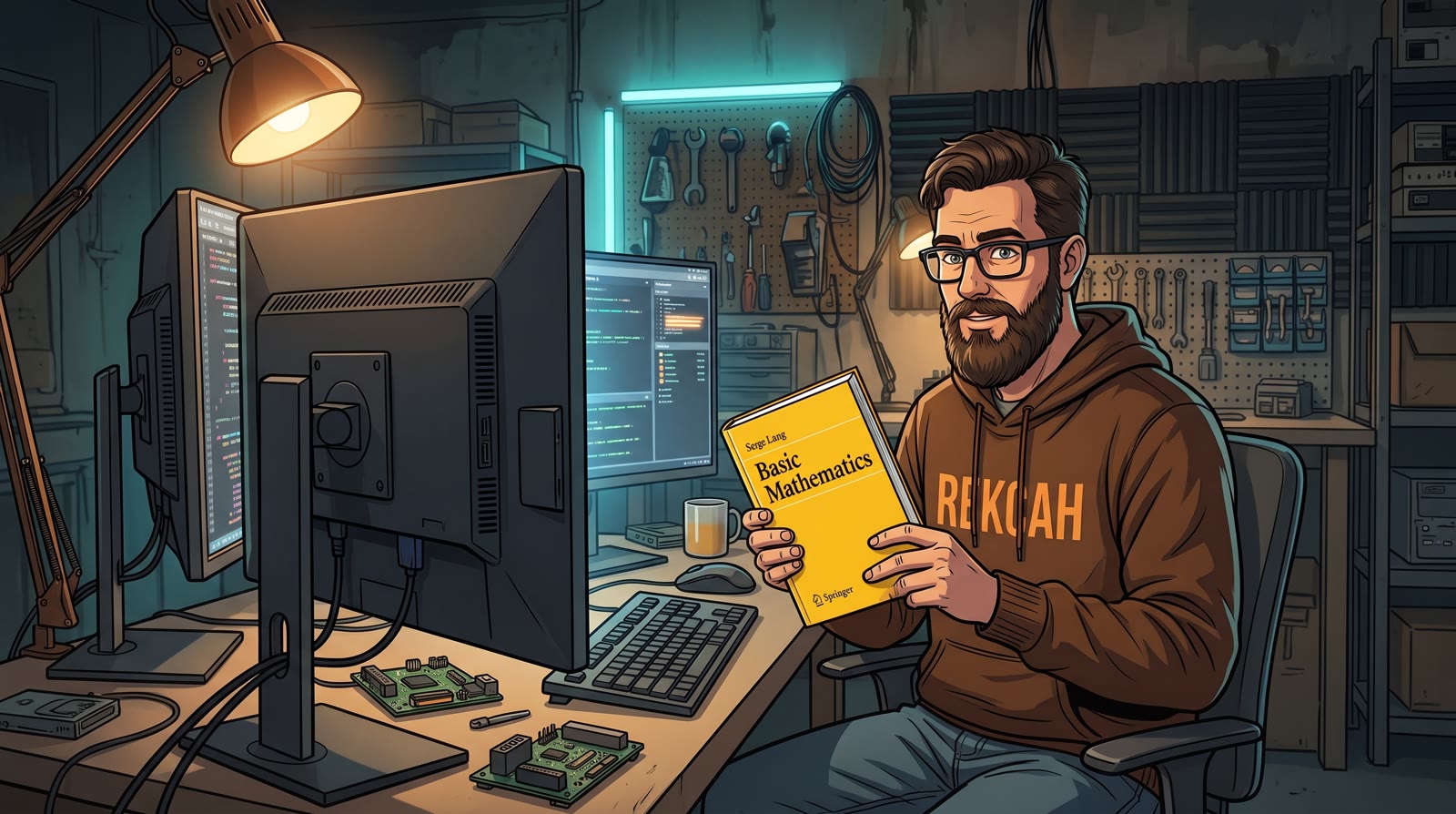
His stream descriptions are honest in a way I love: “Lots of mistakes. Intentionally boring. Random mix of note taking, exercises, and teaching.” Then, on its own line: “Cats!” In January, his early streams were chapter one of a linear algebra textbook. By July, past Day 120, he was working out of a calculus book, Serge Lang’s Basic Mathematics, that same linear algebra book, and a graduate-level book on the math of symmetry. His newest streams are past Day 180.
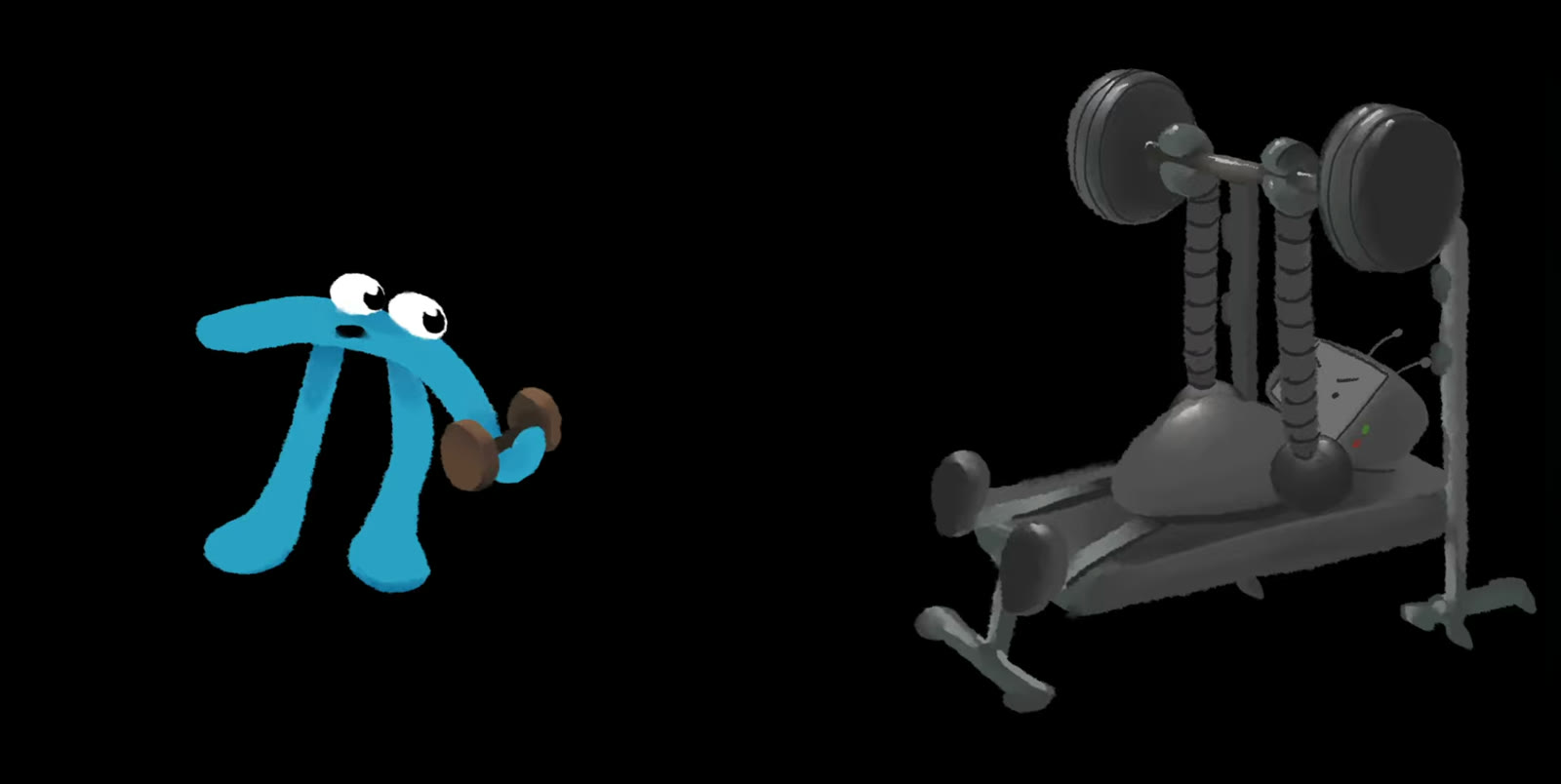
Image courtesy of Grant Sanderson / 3Blue1Brown
That is the gym argument, made real. A model could probably do most of those exercises faster than he can. He does them anyway, on camera, mistakes included, because the point is what happens in his own head. And since grading homework no longer proves anyone did the reps, doing them live in front of people is about as honest as it gets.
Every stream description links to his Discord server, called jcpractices, which has more than 600 members. That is what Grant was talking about: math as a shared thing, not a race. You don’t need to be good at math to show up. You just need to want to practice.
For someone like me, coming to linear algebra late and trying to understand the math under the AI tools I run every day, that is the right kind of room. I do not need a proof machine. I need reps, and I need people around me doing reps too.
If that sounds like you, here is the door:
- Discord: discord.jcpractices.com
- Math streams: youtube.com/@jcpracticesmath
- Guitar practice streams: youtube.com/@jcpractices
- Everything else: linktr.ee/jcpractices
Grant ends his video by saying the math community “has never been more open-minded.” I would add one thing. It has also never been easier to find. Close the laptop and take the walk, sure. Then come back and say hi.
Sources
- Grant Sanderson, There’s never been a better time to go into math, 3Blue1Brown, October 16, 2026.
- Proofs and Prompts: 100 reactions to 100 solutions, linked in Grant’s video description.
- Constantin Kogler, Institute for Advanced Study.
- Jon Crossley, jcpractices math on YouTube, for example Day 4 and Day 123.
- jcpractices on Linktree.